Comb Filtering
When two or more identical audio streams are blended together with a short delay between them, comb filtering occurs. Because frequencies in phase add together, while frequencies out of phase cancel, the resulting frequency response graph resembles a comb.
Phase Interference
Understanding the principles of phase interference helps understand why comb filtering occurs.
Constructive Interference
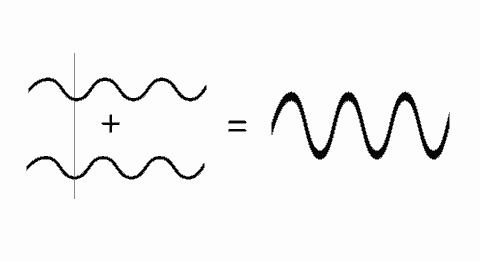
Take a glance at the sound waves below. The frequencies of the waves are identical. They're also in phase, which means the waves rise and fall in unison. They add together and generate a sound wave that is double the original size since they are in phase and have the same amplitude. It's like adding 2 numbers. This phenomenon is known as constructive phase interference.
Destructive Interference
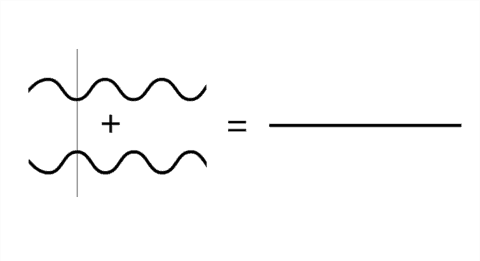
The sound waves in this image are completely out of phase. This means that when one waveform rises, the other falls. Because the waves are the same size and perfectly out of phase, they cancel out completely. These two sounds have no meaning when combined. It's the same as subtracting equal numbers. This is referred to as destructive phase interference.
It is uncommon for the two waves to be perfectly in phase or perfectly out of phase. They are usually partially offset, as shown below. Most of the time, there is a mix of constructive and destructive interference.

It is critical to understand the distinction between phase and polarity. These terms are frequently used interchangeably, but they are not identical!
What does Comb Filtering Look Like?
The name comb filtering comes from the shape it creates on a frequency response graph.
This is a white noise frequency response graph. Because the level of each frequency in white noise is equal, a nearly straight line from 20Hz to 20kHz is created on the graph.

The frequency response graph of the same white noise, but duplicated, is shown below. The duplicated white noise has been time-shifted by 1ms. This graph's line replicates a comb.
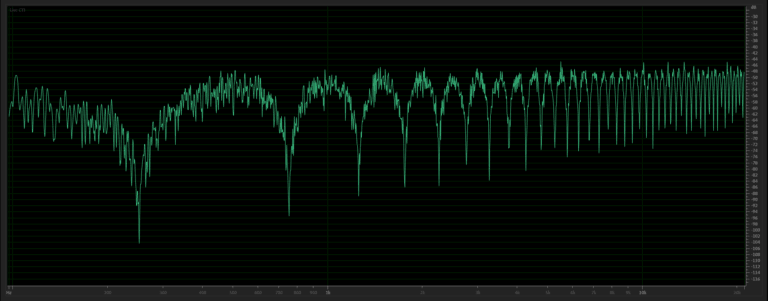
Because some frequencies are perfectly in phase, some are partially in phase, and some are completely out of phase, the comb shape forms. The comb's highest points are frequencies that are perfectly in phase and sum together.
The comb's lowest points are frequencies that are completely out of phase and cancel.
The frequencies in between are out of phase to some extent.
What Does Comb Filtering Sound Like?
The sound of comb filtering or phasing varies depending on which frequencies are canceled. It can be understood better with an audio sample.
Here's an audio sample. First, you'll hear two identical copies of the voice, perfectly timed and in phase. Then you'll hear what happens when one of the voice copies is time-shifted or delayed.
When the signal is delayed by 10ms or 20ms, you can hear the phasing. However, a delay of 50ms does not have the same effect. The signal begins to sound like an echo when it is delayed by 50ms or more.
Time delays ranging from less than 1ms to approximately 25ms produce comb filter effects. Time delays outside of that range produce an echo effect. As a result, for the purposes of this discussion, we will use delay times ranging from 0ms to 25ms.
What Causes Comb Filtering & How to Avoid It?
You already know that comb filtering happens when two or more copies of a signal are combined. Now we'll discuss and illustrate how comb filtering occurs in practical situations. Reflections, multiple speakers, and multiple microphones are the three main categories.
Comb Filtering Caused By Reflections
When a sound is produced, it radiates from the source and bounces off the surfaces in the room. When a sound travels through multiple paths to reach a microphone, the delay caused by longer paths causes some frequencies to be out of phase.
How to Avoid Comb Filtering from Reflections
A few tips to help improve the sound quality recorded in a reflective recording space.
Critical Distance (Direct vs Reflected Sound)
Consider how the force of a soundwave decreases with distance. You can take advantage of this. Place the microphone as close to the sound source as possible so that the direct sound level is significantly louder than the reflected sound level.
Diffusion & Absorption
Everyday sounds are a combination of direct and reflected sounds. It may sound unnatural if the reflections are completely removed. Concentrate on absorbing the first reflections that reach the listener or microphone. Then try breaking up or diffusing reflections. A diffusive surface reflects sound in multiple directions rather than focusing all of the energy in one.
Comb Filtering Caused By Multiple Speakers
You risk causing comb filtering whenever you send the same signal to multiple speakers.
Stereo Systems
Stereo is a popular video format for mixing music and sound. This format, however, causes some issues in practical applications.
The speakers in an ideal mixing environment are equally spaced from the listening position. The speakers' equidistant spacing allows the sound from each speaker to reach your ears at the same time. If you set up your studio in this manner, all frequencies will be perfectly in phase at your listening position, and there will be no comb filtering.
Consumers who listen to your track, on the other hand, are rarely in such a controlled environment. Most listeners will undoubtedly be sitting closer to one speaker than the other, resulting in comb filtering.
Large Audience Live Sound PA Systems
The stereo issue mentioned above also exists in live sound applications. However, another issue is presented in live sound. That is the issue with time-aligning speakers for large audiences.
For some venues, multiple speaker systems are required in live sound. There is usually a main array of speakers on stage and additional speakers beneath balconies. It will take some time for the sound from the main speakers to reach the balcony speakers.
Live sound system technicians delay the signal going to the balcony speakers in an attempt to align these speakers in time and avoid comb filtering.
How to Avoid Comb Filtering from Multiple Speakers
Here are some techniques you can use to reduce the comb filtering effect caused by multiple speakers.
Time Alignment
In live sound, technicians use different delay times for each line array to try to synchronize sounds from all speakers. This is extremely effective. However, perfect time alignment between speakers can only be achieved in one location.
You will be in the sweet spot where sounds are perfectly in phase if you stand directly between the left and right speakers. However, if you move to the left even one step, the signal from the left speaker will reach your ears slightly before the sounds from the right speaker.
It will never be ideal for everyone. Although it is a sad truth, it is a reality. Sound system technicians do everything they can to reduce comb filtering as much as possible, but these issues will always exist with multiple speakers
Comb Filtering Caused By Multiple Microphones
Another cause of comb filtering is the use of multiple microphones near the same sound source.
Stereo Recording
Stereo microphone techniques are an excellent way to enhance the authenticity of your recordings. Stereo microphone techniques are commonly used when recording orchestral music. One of the most common techniques is to use spaced pairs of microphones.
This method produces a recording with a wide stereo image, resulting in a very engaging listening experience. However, if not used with caution, this technique can result in serious phase issues and comb filtering.
Panel Discussions
Panel discussions are another example of how multiple microphones can lead to comb filtering.
This scenario typically involves multiple people speaking at board meetings or on stage with multiple microphones in front of them.
Even though each person has a microphone, their voices will be captured by the microphones of their neighbors and then mixed together. This can leads to phase cancellations.
How to Avoid Comb Filtering from Multiple Microphones
There are a few methods you can use to reduce the comb filtering caused by multiple microphones
The 3:1 Rule
When using multiple microphones, the 3:1 rule can help ensure that there is no significant phase cancellation in your recordings.
The 3:1 rule states that if you have a microphone one meter away from a sound source, there should be at least three meters of space between any nearby microphones.
This provides enough space for sound to be reduced to a level that does not result in significant phase cancellation.
Gain Automation
If you are unable to reduce the level of sound leakage between microphones using separation in space, you can try to gain automation.
For example, if you're mixing a panel discussion with multiple microphones, you can ride the fader for each microphone to increase the level when someone speaks into the microphone and decrease it when it's not in use.
Using multiple microphones will reduce the comb filtering effect. However, this will not work if both microphones are used at the same time.

Let’s talk practically
In a 3D environment, comb filtering is unavoidable. Comb filtering and phase cancellation are everyday occurrences. As audio engineers, all we can do is try to figure out what causes comb filtering and how it can be minimized.
Understood comb filtering without having any prior knowledge. Nicely written 👍
ReplyDeleteInformative !!
ReplyDeletevery informative!!!
ReplyDeleteGood content
ReplyDeleteVery helpful!
ReplyDeleteInformative!!
ReplyDeleteHelpful Content and Nicely written
ReplyDeleteGood presentation and very helpful
ReplyDeletevery helpful content
ReplyDeleteVery helpful content and Nicely written....
ReplyDelete